

This article is part of a series of four covering how AI search could transform websites and how information circulates online. You can access the introduction here.
AI search transforms how information circulates online, not just how we search. I detailed in the previous article a few shifts it is generating for websites and content circulation online :
SHIFT 1 : Informational collapse. AI obliterates traditional content hierarchies. Websites’ content becomes raw material for anybody to create with.
SHIFT 2 : Catalog websites death. AI search will make catalog websites that hoard cold content obsolete and will turn them in data farms.
SHIFT 3 : Content creator - consumer dissolution. Generative AI obliterates the boundary between content creator and followers. Everyone creates as they consume online content.
SHIFT 4 : Automated niche culture. By enabling native language queries AI makes filtering content much finer, hence niche content becoming much more accessible.
SHIFT 5 : Fully commodified uniqueness. AI drops the cost of creating content, art, brands, making their individual uniqueness of each much more vague.
If you want more details and context about those, feel free to access the first article here. As for today we will explore how those shifts impact how cultural brands use their website and share information online.
To answer those paradigm shifts, we must look beyond SEO consultant updating their trade to LLMO (Large Language Model Optimization), control-hungry brands, and UX designers obsessed with display over function. Let's instead turn our gaze towards those who are usually kept away from those topics, those who actually produce and consume content.
Adopting a new perspective
First, let’s consider aspirational window shoppers. Those who can only consume through imagination, speculation. For them, brand exploration is a ritual of desire, yet AI's ruthless efficiency makes this delicate economy of longing less enjoyable. As AI bots and search agents try to impose a rationale on searching, we’ll need to consider how window shopping can still thrive in that environment. And if cultural brand websites can help on that matter.
Then there are prosumers and tastemakers who agree to champion the brand in exchange for a privileged access to information. Gatekeeping is their power; information retention their shield to preserve their social advantage. Yet, AI search obliterates the walls of exclusivity, by making any niche content accessible. We can expect that in the AI-internet, tastemakers will look for new ways to maintain or regain their informational advantage. Therefore on the AI-internet, cultural brands might have to consider how information retention could drive engagement as much product release themselves. The semi-private communities that were experimented with during Covid-19 (Discord, Substack, Patreon…) might become important media for brands and publishers looking to engage their expert consumers.
Also, in an era of loneliness epidemic, (58% of 18-24 year old Brits reporting feeling lonely) we cannot reduce shopping to an economical transaction. It's a social infrastructure. Product exploration is a conversation starter, a social lifeline for many. Yet, despite shopping being a social activity, AI companies’ main aim is to accelerate it. AI search, AI agents will not help them much in engaging in socializing shopping experience. In the coming years cultural brands might have to reconsider their role as a social link and how it could become a new source of revenue for them.
Finally there is the creator class. They often inspire and collaborate with those brands. For those small independent creatives, what are the incentives to share their content online when an AI crawler can absorb their content, their hard work and emulate it indefinitely ? With social media becoming culture-vultures powered by AI, brand domains could become the new safe spaces to create. Cultural brands could become protectors of human creativity by offering to creators a space for their work to be displayed and somewhat protected from AI theft. Part of the future of cultural brands’ websites could lie in protecting, rewarding and using original content, to their advantage.
All those points converge into this one : learning about cultural brands and shopping isn't just an experience to be rationalized - it's leisure, self-expression, social ritual. So why think only about the future of cultural brands’ content and websites through the lens of AI efficiency ?
A more fruitful question
Indeed for a long time, cultural brands used their website to inform about the products. We understand that AI search will probably take on a big chunk of this role. The first estimates predict that the introduction of Google’s Search Generative Experience, with its AI summaries, is expected to cause traffic drops between 18% and 65% for websites. The focus of our attention should not be on how websites should play catchup with AI search. It should not only be about how to integrate more AI into the website to maintain its informational advantage. We should rather focus on how websites and brand content could complement AI tools of information ! If brands and publisher lose the information war to AI giants, they can still win the emotional war. The question should rather be : How could cultural brands retain an emotional advantage in a rational AI internet by developing more meaningful ways to share content online ?
Meaningful = Ensuring that good content cut through the content noise
Meaningful = Giving original content a chance to succeed in a world of duplication
Meaningful = Emancipating from AI and algorithms dependence
To come up with new answers to those questions we can draw inspiration from Remilia.corp who came up with brilliant ideas.
Remilia.corp
The origins
Remilia.corp is an online community that experiments collective ways to create and post content online while trying to emerge in an algorithmically driven creative ecosystem1.
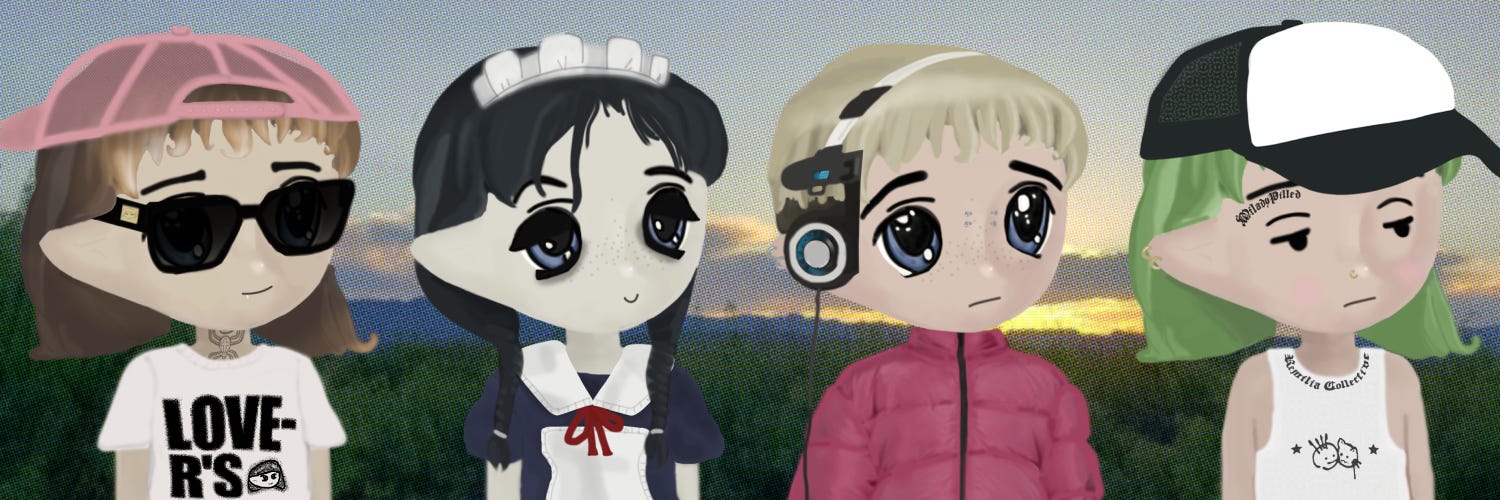
Remilia started out as a group chat around 2021, bringing together individuals from different image board forums. They initially coordinated activities around art production with one of their first projects being the generation of NFT profile pictures of “Remilios” and “Mylaides” during the 2022 NFT craze :
At that time they faced 2 challenges that most cultural brands face:
How to enable collective creativity yet retain a consistent narrative ?
How to create viral content that can cut through the noise and bypass the algorithm dependence ?
To address these questions they experimented the following solutions :
“Collective lore” a way to enable collective content production while staying consistent
“Network Spirituality” a Remilia concept to describe creativity at the protocol level.
Let’s dive into those.
1. Remilia’s “Collective lore”
Like any online collective, over the years of posting, Remilia accumulated a collective lore, a set of aesthetics, and references. The lore did not belong to any individual, it was produced by everyone.
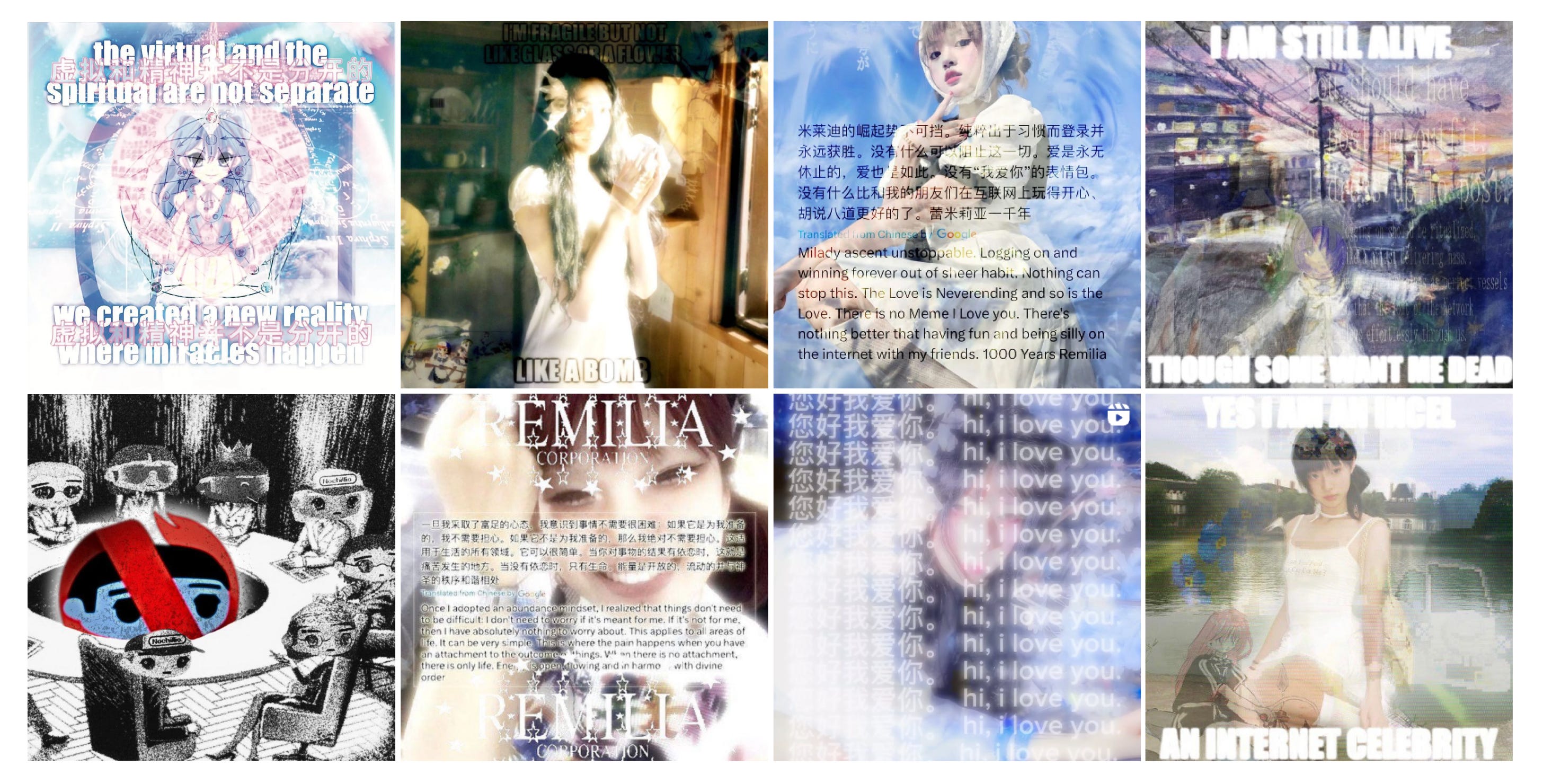
As the community expanded, their collective lore, or mythology as they call it, became more valuable than any individual piece of content they could create. So instead of focusing their attention on individual pieces of content, members of Remilia started to focus their creative attention on the lore itself.
They started to create new lores inspired by the content produced in the Remilia forums, and from the various platforms the community was active on. Then they set up dedicated generative AI tools for each one of those lores. Newcomers could then quickly generate content in tune with the community’s culture. By doing so each newcomers could immediately “fit in” and contribute to Remilia. Moreover, as the lore creators directly integrated visual and textual cues from the social media they originated from, content generated could perform right away on those platforms.
Here is below an example of a content generator dedicated to the “Cheeseworld” lore:
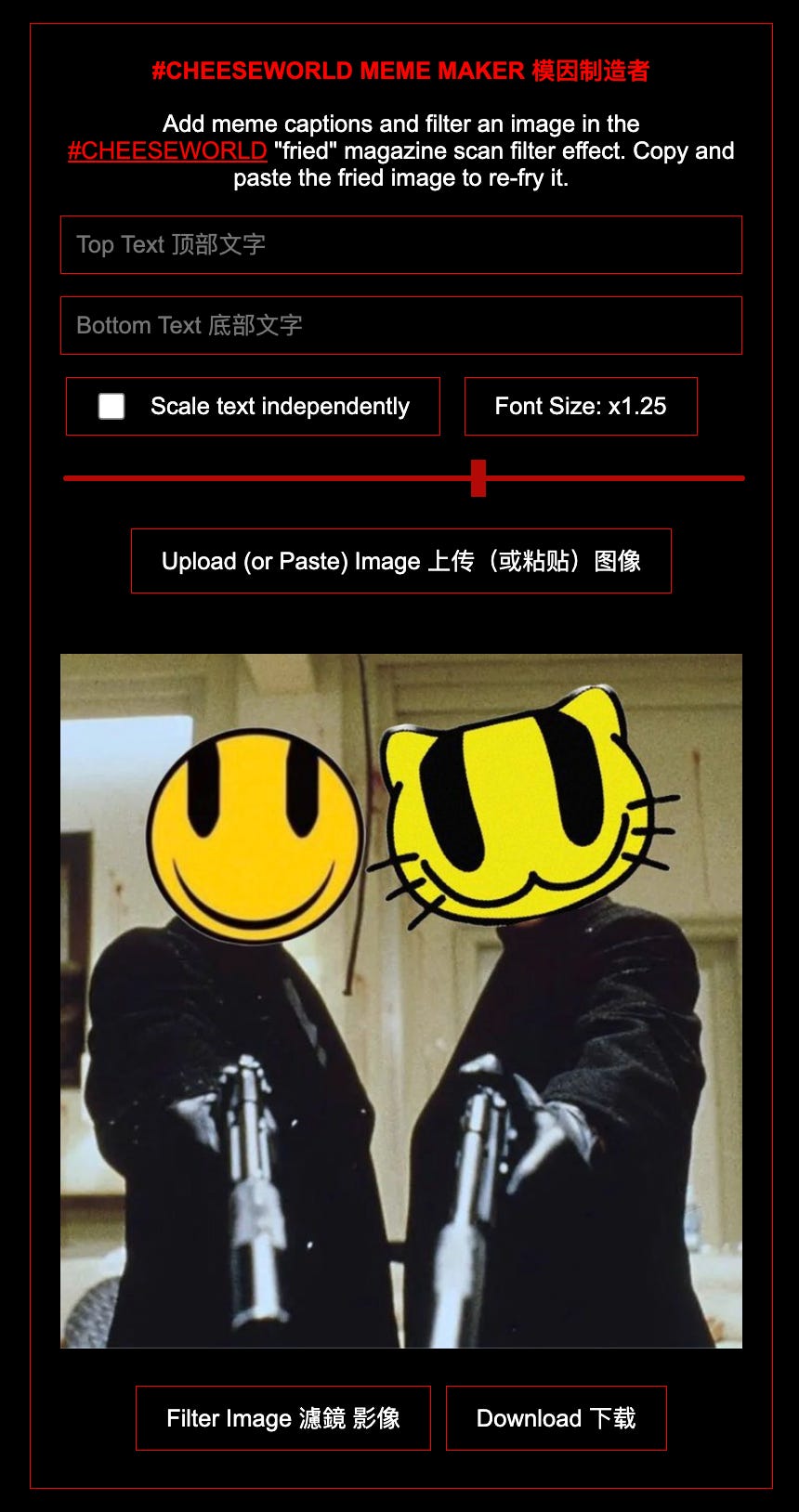
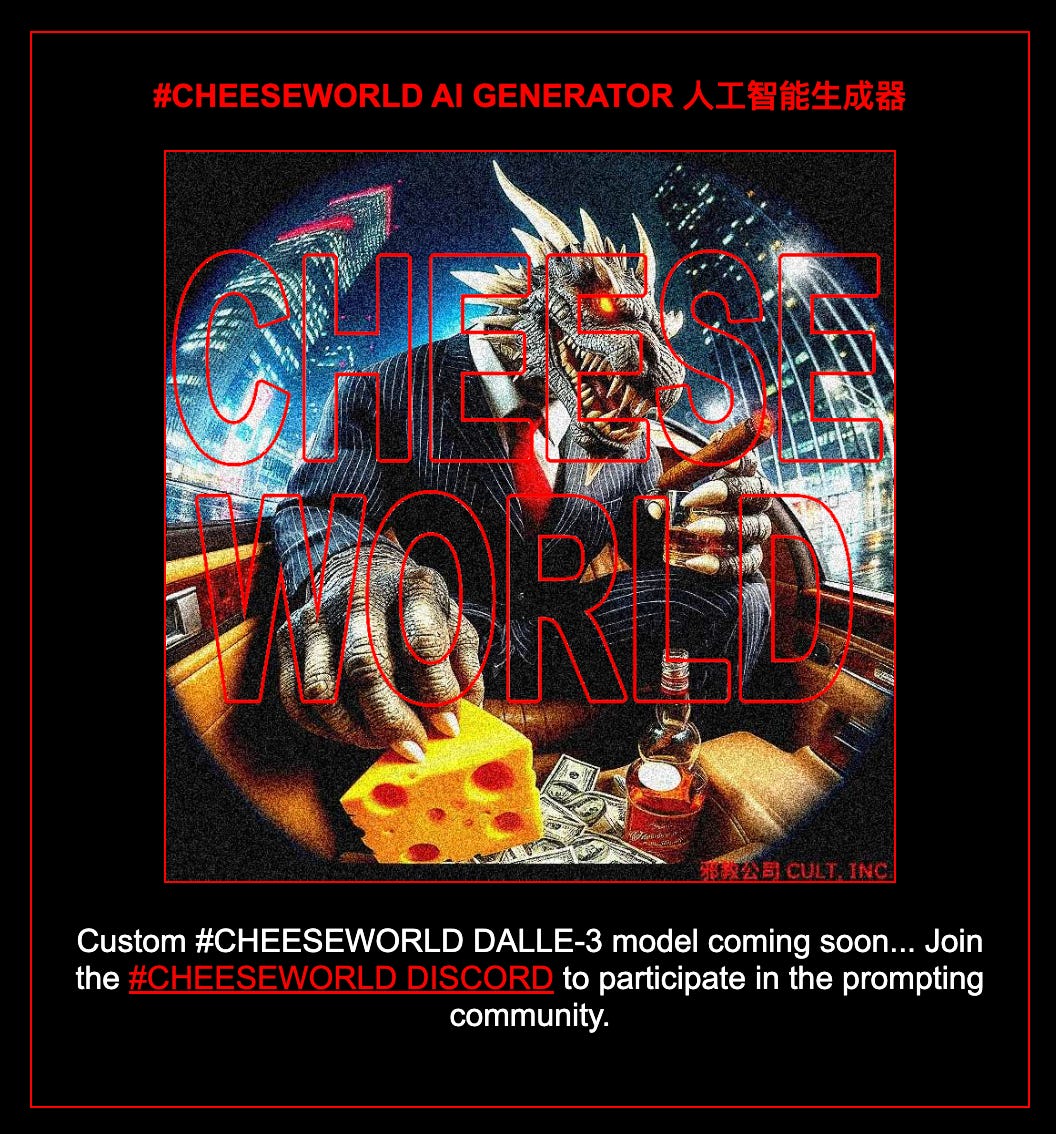
Remilia.corp does not claim any copyrights on any of the pieces of content generated with those tools. Without any type of IP limitations, Remilia content & lore (Cheeseworld in this case) can spread on a wide range of platforms; image board, X, Instagram, digital art marketplaces…
Those very accessible protocols allow for each member to be creative while maintaining a consistent collective narrative. Each individual can get creative with the generators while the lore creators can curate what content is used to further train the AI generator. Quite an impressive feat, and a very contemporary approach to content creation for the AI-internet.
This shift from brand-controlled narratives to collective creativity isn't just inevitable - it's already here. As AI democratizes content creation, the question isn't whether brands will maintain their monopoly on quality content (they won't), but how they'll navigate this new landscape of distributed authorship. Remilia's protocol offers a strategic blueprint: instead of trying to control the conversation, brands need to architect the conditions for collective storytelling.
This means moving beyond the outdated model of brand guidelines as restrictions and towards what we might call 'creative infrastructure' - tools, frameworks, and generative systems that simultaneously enable individual expression while maintaining narrative coherence. Imagine a luxury fashion house releasing AI generators trained on their archive, or a beverage company creating tools that let fans remix their iconic advertising into new forms of cultural expression.
2. Introducing Remilia’s “Network Spirituality” & “Protocol creativity”
Due to technological advances, the cost of creating new products, content, and brands is dropping. This leads to an oversupply making each of their unique value unclear. As it is more and more difficult to emerge with a single piece of content, when content becomes training data, Remilia shows us that on the AI-internet, true creativity happens at the protocol level.
Indeed, the creativity of Remilia lies not in the aesthetic qualities of an individual post but in Remilia’s ability to develop a mythology, or a lore and to embed it in generative AI tools. Remilia “Total art” as they define it is the aim to extend that protocol to the largest amount of platforms, websites, fields. They absorb successful visual cues from Twitter, gaming, crypto, fashion, art world within their gen AI protocol to produce content that can succeed in those spaces. As they explain it in their manifesto :
“The response to this totalization of the Cultural Function must itself be a Total Art that embraces this logic of algorithmic and techno-capitalistic totalization. No node can be safe, no medium untouched, no user unscathed, no ego left intact - the language of this New Art must be pervasive enough to provide a new cartography of the Network itself.”
This “creative protocol” can then be used by each individual users as a framework for individual expression without having to self-brand or overexpose on social. Remilia members are using the lore to express themselves but the lore is also manifesting through them. As L.B Dobis, director of Remilia Quarterly puts it : “Milady gives the user an identity while leaving room for construction - from the get go the Milady poster is engaging in a creative act, breaking through the inertia of needing to question one's self before trying to represent it.”
This is what Remilia theorizes as “Network Spirituality”. The collective subjectivity that manifests through the lore and the protocol and under which individuality is diluting into.
This is quite an interesting concept and approach when we consider the pressure of self exposure on social media, and how people find it harder to enjoy a sense of togetherness and community instead of cult of self affirmation.
What Remilia case could mean for cultural brands
4.1 Opening the websites’s window on semi private spaces
For most, websites were either approached as catalogs of information or window displays. But AI search engines are winning the information war as they prove to be better at providing unbiased tailored information. In the meantime we also see that social media face an oversupply of content and that bot traffic is increasing everywhere so much so that it is estimated that 50% of online traffic today is generated by bots. How can cultural brands ensure that their content reach their audiences in an era of oversupply and bot infestation ?
Cultural brands and media could draw inspiration from Remilia by sharing their content in semi-private spaces : Substacks, mails, Discord channels, logged forums... The content is more protected from AI theft, and cut from the exterior noise. It provides to the most engaged users a sense of content exclusivity tastemakers look for. Allowing for the content produced by brands to be shared but also enriched through collective contributions. This migration to semi-private spaces has already begun for influencers as in 2024, 25% of content creators have moved their business behind paywall. It can be expected that brands will have to move an increasing part of their content to those spaces too.
But we’ve heard about brand communities and semi-private spaces for a while. Do people have time for it and is it easily accessible ? Well, AI assistant can make the content from semi-private spaces (Substack, Discord, mails…) much more accessible and digestable for users. Soon, instead of browsing through all your mail, your Apple intelligence assistant will be able to retrieve the content from your newsletter and make it more practical when you need it. Removing one major downside of those private channels : accessibility.
As shopping and cultural brands remain vital platform for socialization we expect for cultural brands’ websites to host more semi-private spaces and dedicate an increasing amount of their content to those channels in the coming years.
4.2 “Protocol creativity” : the new brand building of the AI-internet
The medium is the message. The message of social media was “everybody can create”, the message of AI is “everyone and everything can be copied”. Duplication has completely commodified uniqueness. So how to still stand out as a cultural brands ? Remilia shows us a way ; on the AI-internet, where information became training data, true creativity no longer lives at a brand level, or a piece of content level, but rather at the protocol level.
A good example of that “protocol creativity” we all know is Balenciaga. Its uniqueness lies more in its creative process than in a defined set of codes. Their protocol is “simple” : taking pieces of popular culture, mainly ugly or deemed unworthy of fashion, turning into fashion that is itself becoming powerful pieces of content. This meme like protocol for creation is accessible and usable to a fan. It is a kind of insider joke, a way for fans to feel part of the brand even if they can’t afford the clothes. Remilia and Balenciaga both don’t try to build a set of brand codes that would be copied or out-fashion in a minute, but instead create a “protocol“ for creativity that can generate many. By doing so, both Balenciaga and Remilia can navigate in a surprising number of fields and platforms and withstand duplication and oversupply of content.
I can expect more brands experimenting to define their identity at the “protocol level”. In order to be more resilient but also to interact with their audience, and ultimately to turn them into content generators while still preserving a cohesive brand narrative all along.
“Protocol creativity” is a fascinating topic and I will dive further into it in further articles..
In the meantime, in the next one we will discuss how AI-internet could impact how small cultural brands build their online presence. How they post and share content online. In which ways they could turn their authenticity into an edge on the AI-internet. How leaving “creators’ fingerprints” on the content they create could become a way to make their content more unique and less duplicable.
See you in the next article
The algorithmic mindset is a totalizing force that colonizes creativity, and extends its logic of optimization from digital platforms into the physical realm of human experience. What you do IRL is also driven by algorithms.